

Authored by Filip, Co-Founder of Blockchain Collab, the creators of Henry Coder.
The Challenge
Let’s start with the real challenge - going from being an expert to a newbie.
Have you ever wanted to build something on a new blockchain, but hit a wall while learning a new programming or smart contract language?
Have you ever wanted to move from Solidity to a more secure custom language but just didn’t have time to learn it?
Let me tell you - you’re not alone.
Many developers have had exactly the same thoughts and experiences. They spent years learning Solidity or Rust, so moving over to a new chain (especially non-EVM compliant) feels like a waste of their time.
They look at custom languages and all the issues they solve (more about it later) and weep. Without an easy way to translate their experience directly, they go from an expert to a newbie with one decision: “Let’s build on this new chain”.
The Reason
Solving issues with Solidity.
So, why would you do it to yourself? Why set yourself back in your development experience?
We can start to answer that by looking at Alephium and the problems Ralph - its custom language - is solving.
Ralph is built on a stateful Unspent Transaction Output (sUTXO) model, while Solidity uses the classic account model. This distinction is important, because in this hybrid model each contract has its own state (which persists). That state can be modified across transactions.
This difference leads to no in-between states, where assets are sent to another contract or are being called back before updates are finalized. As a result, issues like reentrancy are eliminated, as there is a built-in locking mechanism and explicit asset scoping that prevents exploits like reentrancy or partial state updates.
Another risk with Solidity is approval issues. While writing in Solidity you have to always remember about every permission; one mistake and you create an exploit. Fortunately, Ralph solves it! You might ask, “How?” Well, simple. Every asset is UTXO-bound (so only one-time use) and is scoped to a particular transaction. Instead of relying on implicit state changes, you only have explicit inputs and outputs.
So why doesn’t everyone just write in Ralph instead of Solidity?
That’s probably because Solidity was created in 2014 and is used by Ethereum, Polygon, BSC, and many more, while the latter came to life in 2021 and is only used by Alephium. It will take some time to reverse the 7-year head start in adoption.
THE SOLUTION
How to move quickly and safely?
Once the learning curve has been flattened and the complexity tax has been lifted, the difficulty level can go from Elden Ring to Tetris.
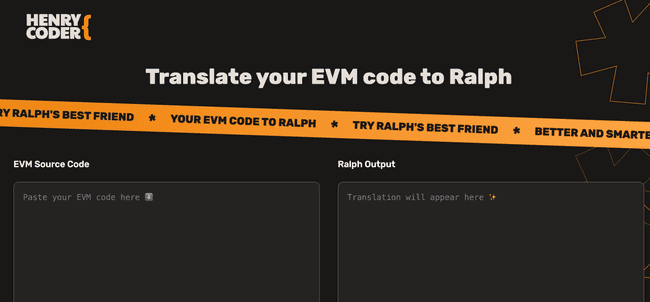
Blockchain Collab created Henry Coder - the first AI translation tool porting code from Solidity to Ralph. Using this tool you can write in Solidity and translate it to Ralph.
This outcome is 87% less time to deploy a new smart contract in Ralph using only your Solidity skills. You no longer go straight to “newbie” status.
By using the AI-powered Henry Coder tool, you combine the best of both worlds: your Solidity Skills and Ralph’s built-in security. You also gain access to an amazing community ready to help you build, deploy, and test in real time.
There’s only one question left… Are you ready to build on Alephium?

![After the Boom: Why 2025’s Prediction Market Surge Demands Decentralization [Part 1]](/static/dc61b936d9e09ff526cf87eb22861836/e9d78/article-permisioned-l1-3-.webp)
![The Rise of Super dApps & Why Web3 Is Finally Growing Up [Part 1]](/static/c5cc5e463a56a55bee3ba1084e8ae147/e9d78/group-59.webp)